Valid Do Not Resuscitate Order Form for the State of Florida
The Florida Do Not Resuscitate Order (DNRO) form is an important legal document designed to communicate a person's wishes regarding resuscitation efforts in the event of a medical emergency. This form allows individuals to express their desire to forgo cardiopulmonary resuscitation (CPR) and other life-sustaining treatments if their heart stops beating or they stop breathing. It is crucial for patients, especially those with terminal illnesses or severe medical conditions, to understand how to complete this form properly to ensure their healthcare providers honor their preferences. The DNRO must be signed by a physician and the patient or their legal representative, and it should be readily accessible in medical settings. Additionally, the form is recognized across Florida, making it a vital tool for ensuring that patients receive care aligned with their personal values and medical wishes. Understanding the implications and requirements of the DNRO can empower individuals to make informed decisions about their healthcare and end-of-life preferences.
PDF Specifics
| Fact Name | Details |
|---|---|
| Definition | A Florida Do Not Resuscitate Order (DNRO) is a legal document that informs medical personnel not to perform cardiopulmonary resuscitation (CPR) in the event of cardiac arrest. |
| Governing Law | The DNRO in Florida is governed by Florida Statutes, specifically Section 401.45. |
| Eligibility | Any adult can create a DNRO, but it is typically used by individuals with serious health conditions or terminal illnesses. |
| Form Requirements | The DNRO must be signed by the patient and a physician, indicating that the patient understands the implications of the order. |
| Placement | The DNRO should be prominently displayed in the patient's medical records and, ideally, on their person, such as on a bracelet or necklace. |
| Revocation | Patients can revoke their DNRO at any time, verbally or in writing, and should notify their healthcare providers accordingly. |
| Emergency Medical Services | Emergency medical personnel are required to honor a valid DNRO when they arrive on the scene of a medical emergency. |
| Advance Directives | A DNRO is a type of advance directive, which allows individuals to express their healthcare preferences in advance. |
| Confidentiality | Like other medical documents, DNROs are protected under privacy laws, ensuring that the patient's wishes are kept confidential. |
| Additional Considerations | It is advisable for individuals to discuss their DNRO with family members and healthcare providers to ensure that everyone understands their wishes. |
How to Write Florida Do Not Resuscitate Order
Completing the Florida Do Not Resuscitate Order form is an important step in making your healthcare preferences known. Once filled out, the form should be signed and dated, and a copy should be provided to your healthcare provider. This ensures that your wishes are respected in a medical emergency.
- Obtain a copy of the Florida Do Not Resuscitate Order form. You can find it online or request one from your healthcare provider.
- Begin filling out the form by entering your full name in the designated space.
- Provide your date of birth. This helps to identify you accurately.
- Include your address. Make sure to write it clearly.
- Next, indicate whether you are an adult or a minor. If you are a minor, a parent or legal guardian must sign the form.
- Sign the form in the appropriate section. This signature confirms that you understand and agree to the contents of the document.
- Date the form on the line provided. This is crucial for ensuring the form is current.
- If applicable, have a witness sign the form. The witness must be an adult who is not related to you or your healthcare provider.
- Make copies of the completed form. Keep one for your records and provide copies to your healthcare provider and any family members involved in your care.
Florida Do Not Resuscitate Order Example
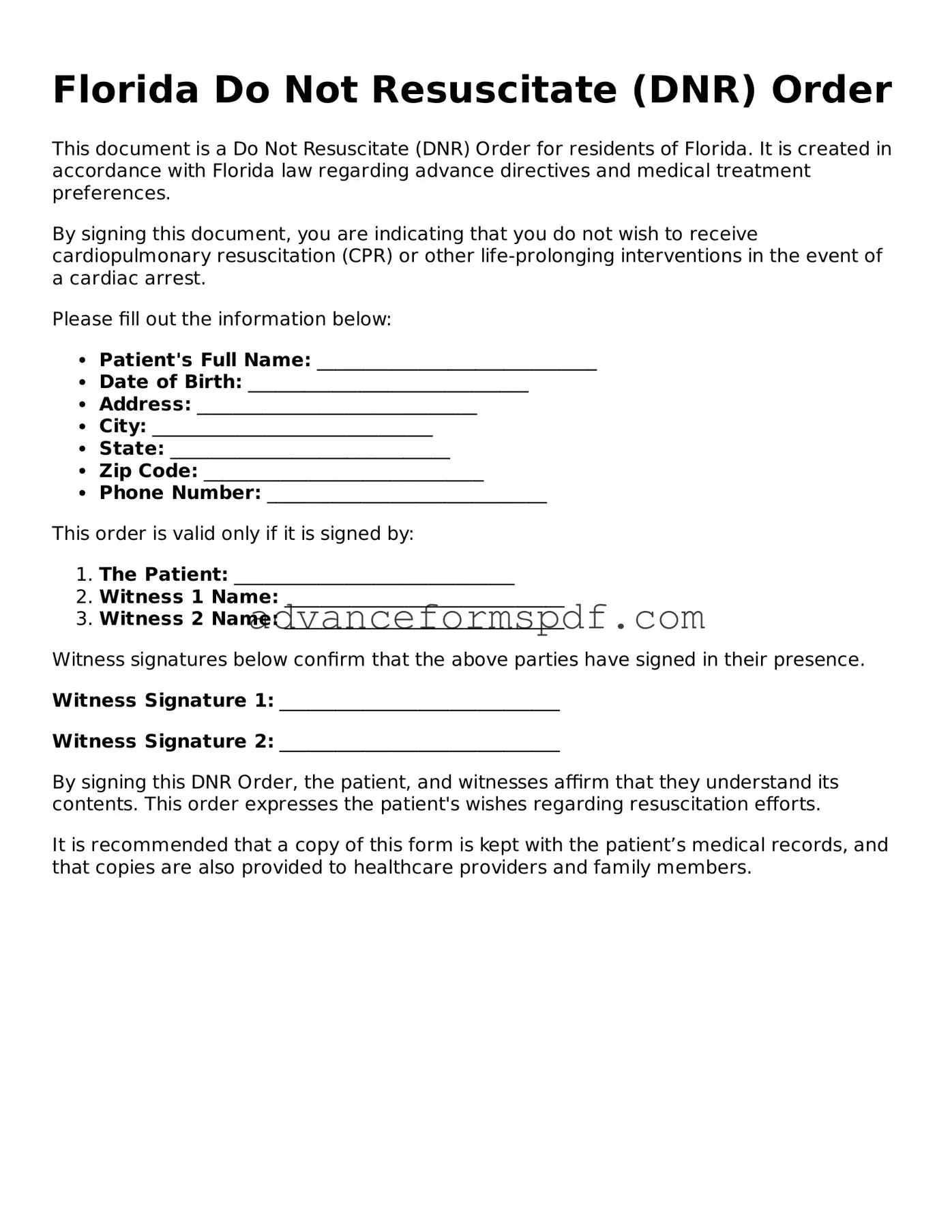
Florida Do Not Resuscitate (DNR) Order
This document is a Do Not Resuscitate (DNR) Order for residents of Florida. It is created in accordance with Florida law regarding advance directives and medical treatment preferences.
By signing this document, you are indicating that you do not wish to receive cardiopulmonary resuscitation (CPR) or other life-prolonging interventions in the event of a cardiac arrest.
Please fill out the information below:
- Patient's Full Name: ______________________________
- Date of Birth: ______________________________
- Address: ______________________________
- City: ______________________________
- State: ______________________________
- Zip Code: ______________________________
- Phone Number: ______________________________
This order is valid only if it is signed by:
- The Patient: ______________________________
- Witness 1 Name: ______________________________
- Witness 2 Name: ______________________________
Witness signatures below confirm that the above parties have signed in their presence.
Witness Signature 1: ______________________________
Witness Signature 2: ______________________________
By signing this DNR Order, the patient, and witnesses affirm that they understand its contents. This order expresses the patient's wishes regarding resuscitation efforts.
It is recommended that a copy of this form is kept with the patient’s medical records, and that copies are also provided to healthcare providers and family members.
Other Do Not Resuscitate Order State Forms
Can You Have a Dnr at Any Age - A DNR order may vary by state in terms of legal requirements and enforceability.
For those looking to navigate the process of selling or buying a recreational vehicle, it is important to understand the specifics of the Arizona RV Bill of Sale form. This essential document not only provides proof of ownership transfer but also includes vital information such as the details of both the buyer and seller, vehicle specifications, and the agreed-upon sale price. To facilitate this process and avoid any ambiguities, you can find the necessary form at Arizona PDF Forms, ensuring both parties are protected and informed throughout the transaction.
How Old Do You Have to Be to Get a Dnr - Communication of DNR status is critical for healthcare teams during emergencies.
Illinois Do Not Resuscitate - Educating family members about a DNR order can ensure everyone understands and respects the patient’s wishes.