Valid Do Not Resuscitate Order Form for the State of Illinois
In Illinois, the Do Not Resuscitate (DNR) Order form plays a crucial role in ensuring that individuals receive medical care aligned with their personal wishes during critical health situations. This legally recognized document allows patients to express their desire not to undergo cardiopulmonary resuscitation (CPR) in the event of cardiac arrest or respiratory failure. The form is designed to be straightforward, enabling patients or their healthcare proxies to clearly communicate their preferences. It is essential for the DNR Order to be signed by a licensed physician, as this adds a layer of legitimacy and ensures that medical personnel are aware of the patient's wishes. Additionally, the form must be readily accessible, often kept in a visible location or with other important medical documents, so that emergency responders can easily find it when necessary. Understanding the implications of this form is vital for patients, families, and healthcare providers alike, as it helps facilitate conversations about end-of-life care and ensures that individuals receive the treatment they truly desire.
PDF Specifics
| Fact Name | Description |
|---|---|
| Governing Law | The Illinois Do Not Resuscitate Order is governed by the Illinois Compiled Statutes, specifically 410 ILCS 50/1 et seq. |
| Purpose | This form allows individuals to express their wishes regarding resuscitation efforts in the event of cardiac arrest. |
| Eligibility | Any adult can complete a Do Not Resuscitate Order, provided they are capable of making their own medical decisions. |
| Signature Requirements | The form must be signed by the individual or their legally authorized representative, and a physician must also sign it. |
| Availability | The Illinois Do Not Resuscitate Order form is available online and can be printed for use. |
| Revocation | Individuals can revoke their Do Not Resuscitate Order at any time, and this can be done verbally or in writing. |
How to Write Illinois Do Not Resuscitate Order
Completing the Illinois Do Not Resuscitate Order form is an important step in expressing your healthcare preferences. This document allows individuals to communicate their wishes regarding resuscitation efforts in the event of a medical emergency. Follow these steps carefully to ensure that your form is filled out correctly.
- Obtain the Illinois Do Not Resuscitate Order form. This can typically be found online or through healthcare providers.
- Begin by filling in your full name and date of birth at the top of the form.
- Next, provide the name of your healthcare provider or physician who will be overseeing your care.
- Indicate the date on which you are completing the form.
- In the designated section, clearly state your wishes regarding resuscitation. You may check the appropriate box to indicate your preference.
- Sign and date the form at the bottom. This signature confirms that you understand the content and implications of the order.
- Have a witness sign the form. The witness must be someone who is not related to you and does not stand to benefit from your estate.
- Make copies of the completed form for your records and provide copies to your healthcare provider and any family members involved in your care.
Once the form is completed and distributed, it will be part of your medical records. This ensures that your healthcare team is aware of your preferences and can act accordingly in a medical emergency.
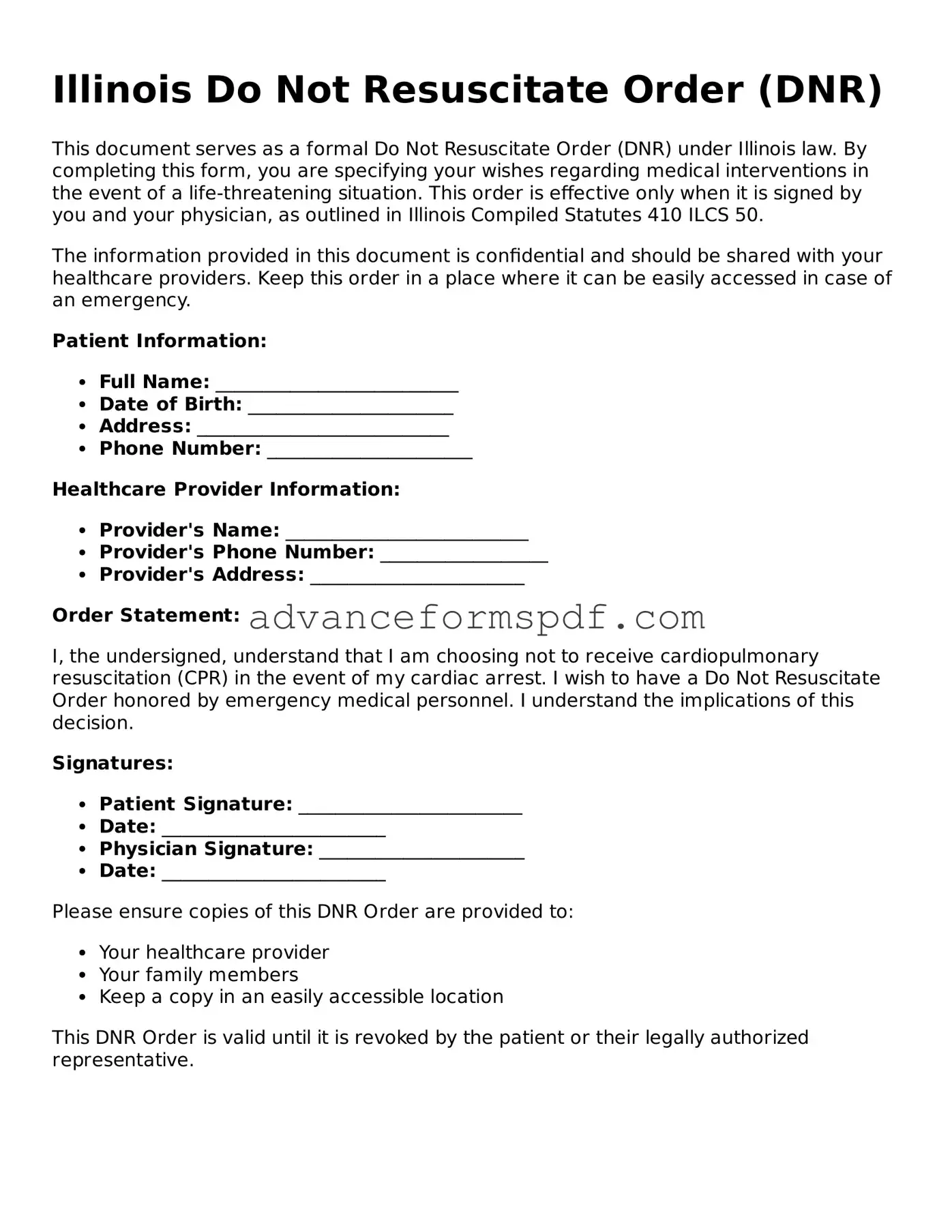
Illinois Do Not Resuscitate Order Example
Illinois Do Not Resuscitate Order (DNR)
This document serves as a formal Do Not Resuscitate Order (DNR) under Illinois law. By completing this form, you are specifying your wishes regarding medical interventions in the event of a life-threatening situation. This order is effective only when it is signed by you and your physician, as outlined in Illinois Compiled Statutes 410 ILCS 50.
The information provided in this document is confidential and should be shared with your healthcare providers. Keep this order in a place where it can be easily accessed in case of an emergency.
Patient Information:
- Full Name: __________________________
- Date of Birth: ______________________
- Address: ___________________________
- Phone Number: ______________________
Healthcare Provider Information:
- Provider's Name: __________________________
- Provider's Phone Number: __________________
- Provider's Address: _______________________
Order Statement:
I, the undersigned, understand that I am choosing not to receive cardiopulmonary resuscitation (CPR) in the event of my cardiac arrest. I wish to have a Do Not Resuscitate Order honored by emergency medical personnel. I understand the implications of this decision.
Signatures:
- Patient Signature: ________________________
- Date: ________________________
- Physician Signature: ______________________
- Date: ________________________
Please ensure copies of this DNR Order are provided to:
- Your healthcare provider
- Your family members
- Keep a copy in an easily accessible location
This DNR Order is valid until it is revoked by the patient or their legally authorized representative.
Other Do Not Resuscitate Order State Forms
How Old Do You Have to Be to Get a Dnr - Healthcare providers may facilitate conversations about DNRs with their patients.
It is crucial for individuals to familiarize themselves with the process of establishing a Medical Power of Attorney, as this legal document enables the appointment of someone to make vital healthcare decisions on your behalf. For those residing in Arizona, resources such as Arizona PDF Forms provide valuable guidance on how to properly complete this form and ensure that your healthcare preferences are protected at all times.
Can You Have a Dnr at Any Age - A DNR does not mean medical care is withheld; it only pertains to resuscitation efforts.